
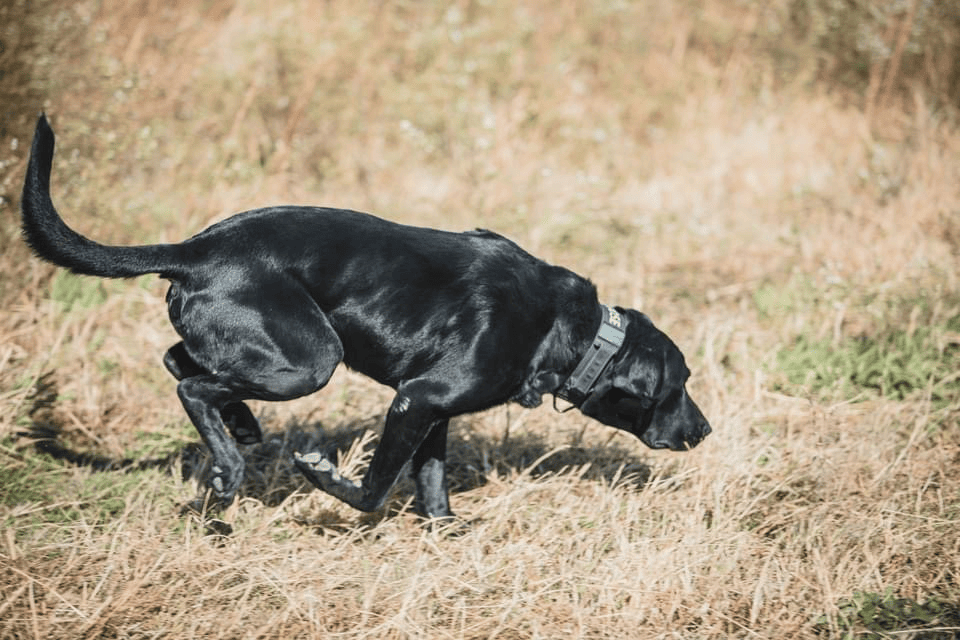
A new study out of Auburn's Canine Performance Sciences program tracked 304 detection dogs from three months old through twelve, scoring them at four checkpoints on eleven behavioral traits — things like how a dog handles new places, noise, and stress, alongside raw detection performance. Feed all of that into a model, and the twelve-month score predicted which dogs actually made it through training with 74.3% accuracy.
Here's the part that applies way outside detection work: it wasn't the score itself that separated the dogs who succeeded from the ones who didn't. It was the direction it was moving. Successful dogs' scores climbed at every checkpoint. The dogs who washed out had scores that just sat flat — not necessarily bad early on, just never trending anywhere.
I see this play out constantly with puppies and young dogs who aren't headed for detection work at all. A pup who's a little unsure at three months but visibly more confident by six, and more confident still by ten, is in a completely different place than a pup who's the same unsure dog at ten months that he was at three — even if, on any single day you checked in, they looked about the same. One is building. One is stuck. And you can only tell the difference by looking at more than one point in time.
That's the trap with a single evaluation, whether it's a formal temperament test, a trainer's first impression, or just your own gut check after a rough week. One snapshot tells you where a dog is. It doesn't tell you where he's headed. If you're only ever checking in once — or only checking in when something's going wrong — you're missing the actual signal.
So if you're watching a young dog grow, or working through something hard with an older one, the useful question isn't "how's he doing right now?" It's "compared to a month ago, is this moving in the right direction?" That's the question that actually tells you something.
Sources:
- Zheng, J., Lazarowski, L., Lanier, A. L., Haney, P. S., Chester, E. M., Waggoner, P., & Wang, X. (2026). Behavioral components define operational suitability metric for detection dog success. Frontiers in Veterinary Science. https://doi.org/10.3389/fvets.2026.1887925